Lateral Impact Protection System (SIP): How It Works, History, and Why It Saves Lives
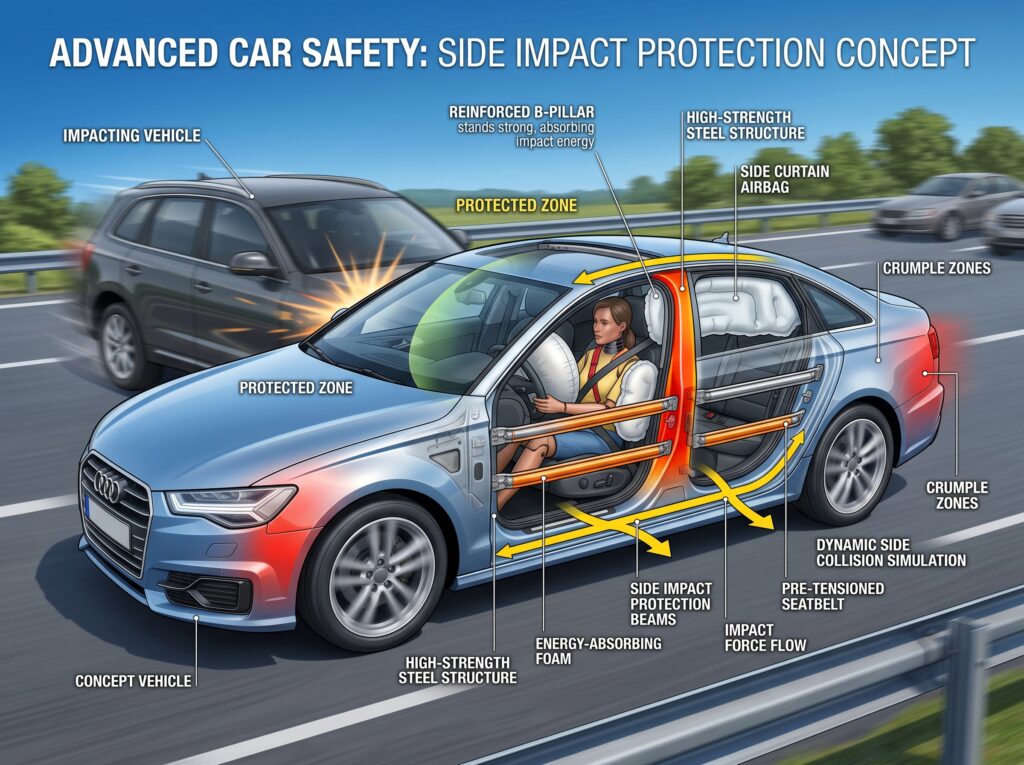
The Lateral Impact Protection System, universally known as **SIP**, is one of the most brilliant and life-saving engineering solutions in modern automotive history. While frontal safety has been studied for decades, side impacts present a unique and dangerous challenge because there is very little space between the outside of the car and the passengers. Thanks to innovations like SIP, the risk of serious injury or death in side collisions has dropped dramatically. In this complete guide, we explain exactly how it works, who invented it, the numbers behind its effectiveness, and why it is non-negotiable in any modern vehicle.
🛡️ What is the SIP System? Core Concept
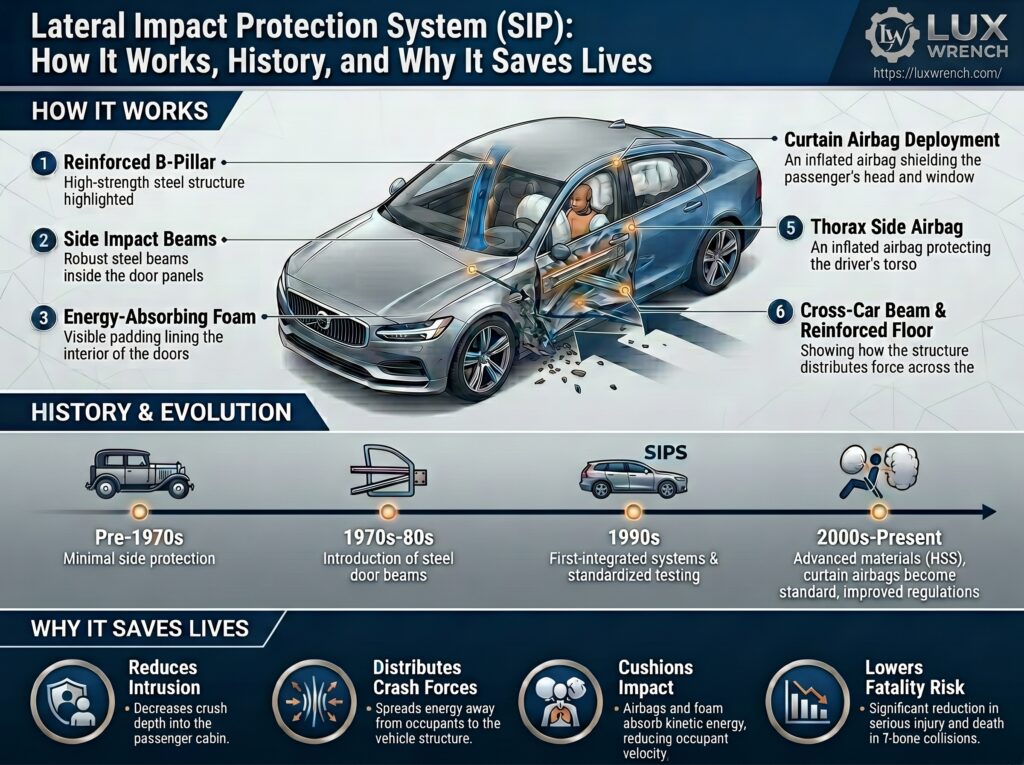
At its simplest definition, SIP is a complete safety architecture designed to protect the cabin and its occupants when hit from the side. Unlike frontal collisions, where the long engine bay acts as a buffer, side impacts happen right next to the passenger. The system solves this problem using a three-part strategy: **Resist, Absorb, and Protect**.
- Reinforced Structure (The Safety Cell): The core is a rigid cage made of ultra-high-strength steel (often boron steel or advanced alloys). Key pillars (B-pillar, between front and rear doors), side sills, and crossmembers are reinforced to not collapse or deform easily. This creates a “survival space” that maintains its shape, keeping the impact force outside the cabin.
- Energy Absorption: Surrounding this rigid cage are specially designed zones and materials (foams, honeycomb structures, reinforced plastic) that crush and deform in a controlled way. Their job is not to be strong, but to *consume* the energy of the crash, slowing it down before it reaches the passengers.
- Reinforced Anchorage: Even the seats are part of SIP. They are mounted stronger and reinforced to stay in place and support the body, preventing excessive movement or collapse during the crash.
💨 Side Airbags: The Fastest Safety Component
While the steel structure protects the body, the side airbags protect the most vulnerable parts: the chest, abdomen, and especially the head. This is the most advanced and visible part of the SIP system.
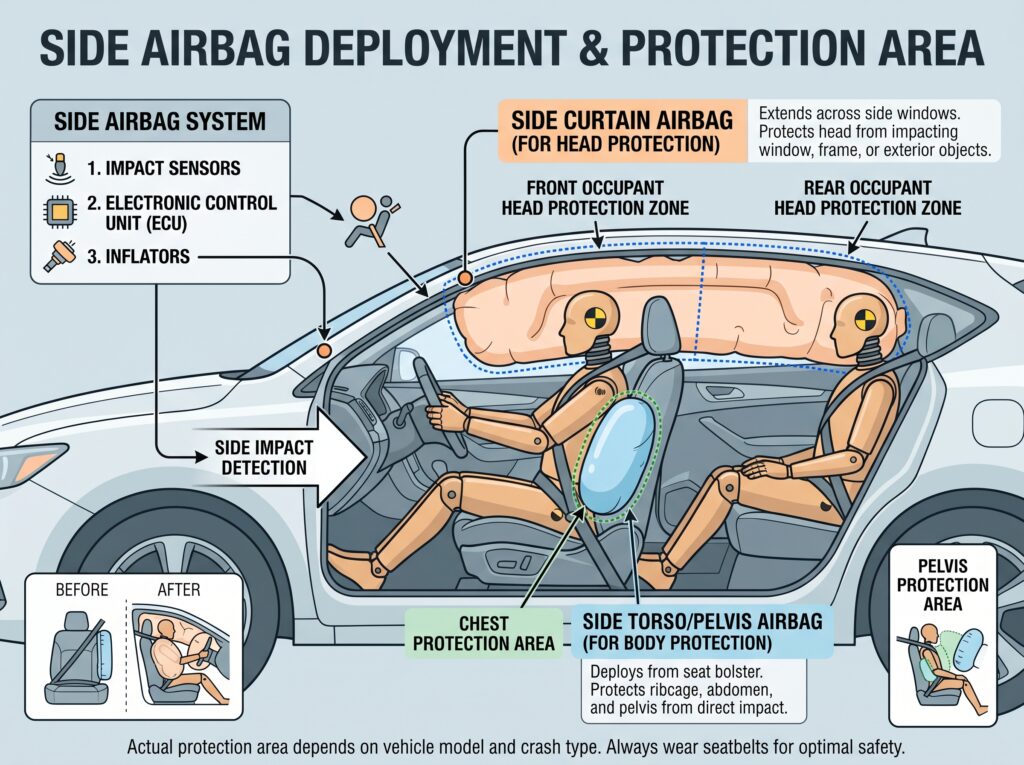
⚡ Incredible Speed and Precision
Side collisions happen in the blink of an eye, so the system must react instantly:
- Deployment speed: **Approx. 300 km/h (185 mph)** — faster than the blink of an eye.
- Time to fully inflate: **Only 4 milliseconds (0.004 seconds)**.
- Coverage: Modern systems use two types: Thorax/Pelvis bags (in the seat or door) and Curtain Airbags (that drop down from the roof, covering the entire window area from front to back).
They create a soft barrier between you and the door, window, or the other vehicle. Without them, your head or chest would hit hard metal or glass directly.
⚠️ Why Side Impacts Are So Much More Dangerous
Understanding the danger helps understand why SIP is such a breakthrough:
- ❌ No Crumple Zone: In a front crash, you have 1–1.5 meters of engine, metal, and plastic to absorb the blow. On the side, you only have the thickness of the door panel: **less than 20 cm** between the outside and your body.
- ❌ High Position: Side impacts often hit at chest or head level, exactly where vital organs are located.
- ❌ Secondary Movement: The force pushes you sideways violently. Loose objects become projectiles, and your body swings dangerously.
For these reasons, side collisions were historically the most fatal type of accident. SIP changed that statistic completely.
📜 History: Volvo — The Pioneer Who Changed Everything
Just like the three-point seatbelt (invented by Volvo in 1959), the Side Impact Protection System is another gift from this brand to global safety. Volvo realized in the late 80s that side crashes were the last big unsolved problem.
- ✅ 1991: Introduction of the world’s first complete SIP system in the Volvo 850 model. It introduced the reinforced side structure and energy-absorbing materials.
- ✅ 1994: Added the first side airbags as standard equipment.
- ✅ Industry Adoption: The success was immediate. Crash test results showed massive improvements. Every manufacturer followed, developing their own versions (Side Guard, PRO-TECT, etc.), but the concept remains the same: **a rigid cage + energy absorption + airbags**.
Today, SIP is mandatory in almost every country and is the baseline for any 5-star safety rating.
📊 Real Results: How Many Lives Does It Save?
We don’t just know it works; we have exact numbers from crash data and insurance studies:
- ✅ Chest & Abdomen Protection: When combined with side airbags, **reduces severe injuries by up to 50%**. This is critical because chest injuries are the most common cause of death in side impacts.
- ✅ Head Protection: Curtain airbags are the game-changer here. They reduce **head injuries by up to 75%**, preventing skull fractures and brain trauma, which are often fatal.
- ✅ Overall Survival: Vehicles equipped with SIP and full side airbags are **3x safer** in lateral collisions than older models without this technology.
🔗 The Golden Rule: Airbags Work WITH Seatbelts
It is vital to remember: **SIP and airbags are SUPPLEMENTARY restraints, NOT replacements for seatbelts.**
The system is designed assuming you are sitting correctly and restrained. If you are not wearing a belt, the airbag cannot protect you properly, and you might even be injured by the deployment itself. Maximum safety = **Reinforced Structure + Airbags + SEATBELT**.
📹 Video Explanation: How Side Impact Protection Works
Watch this animation to see exactly how the structure absorbs energy and how the airbags deploy to protect the cabin:
📌 Conclusion
The Lateral Impact Protection System is one of the most important achievements in automotive safety history. It solved a problem that seemed impossible: protecting passengers when there is almost no space to absorb the impact.
By combining ultra-strong steel to keep the cabin safe, smart materials to drain energy, and airbags that deploy faster than the eye can see, SIP drastically reduces the risk of death or serious injury. From Volvo’s pioneering work in the 90s to being standard equipment today, this technology has saved countless lives.
When buying a car, always check for full side protection: reinforced pillars, side airbags for chest/pelvis, and **curtain airbags** covering the windows. It is not just a feature; it is your best defense against one of the most dangerous accidents on the road.