Why You Should Never Drive With an Almost Empty Fuel Tank: Risks and Consequences
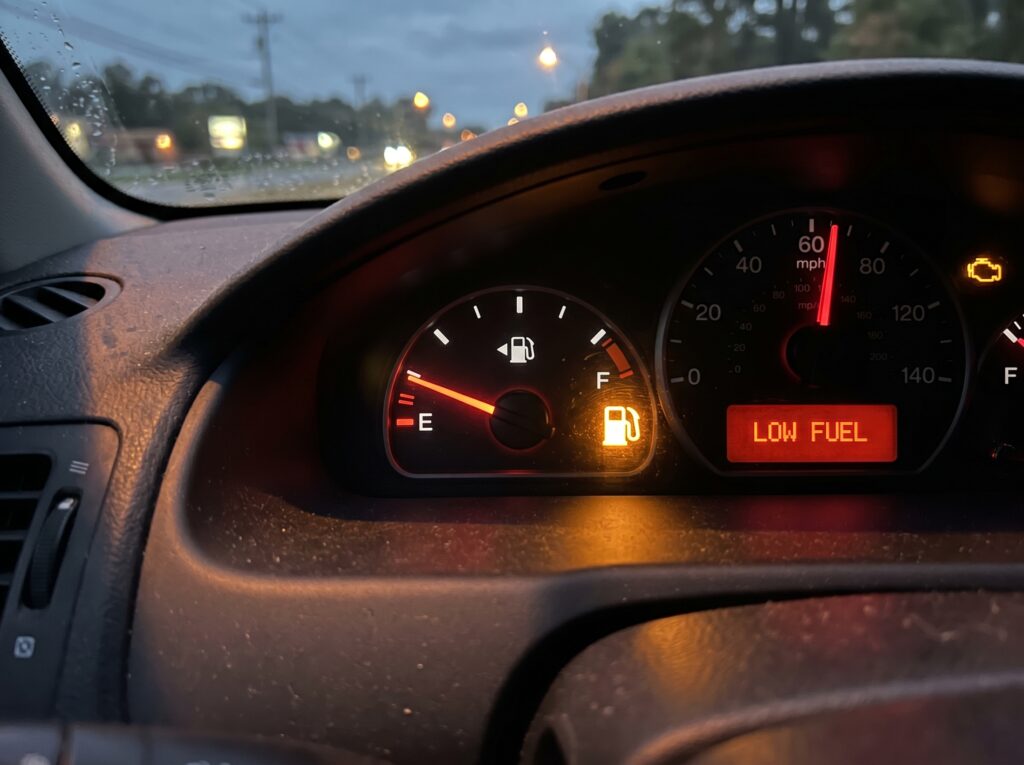
It is an extremely common habit among drivers: waiting until the fuel warning light turns on, or even until the tank is almost completely dry, before stopping to refuel. Many people do it to save money, to control expenses, or simply out of forgetfulness. However, what seems like a harmless or practical habit is actually one of the most dangerous and damaging things you can do to your vehicle. Driving with low fuel levels is not just an inconvenience; it is a practice that causes serious mechanical damage, shortens the life of key components, and leads to very expensive repairs that could have been easily avoided.
In this complete guide, we explain exactly what happens inside your car when you run low on fuel, the 5 main risks you face, and the correct recommendation to keep your engine healthy, powerful, and reliable for many years.
🔍 1. Severe Damage to the Fuel Pump
This is the most critical and expensive consequence of driving on an empty tank, and surprisingly, many drivers do not know how this system works. The fuel pump is the electric component located inside the fuel tank, and its job is to pressurize gasoline or diesel and send it to the engine with the exact pressure required for perfect combustion.
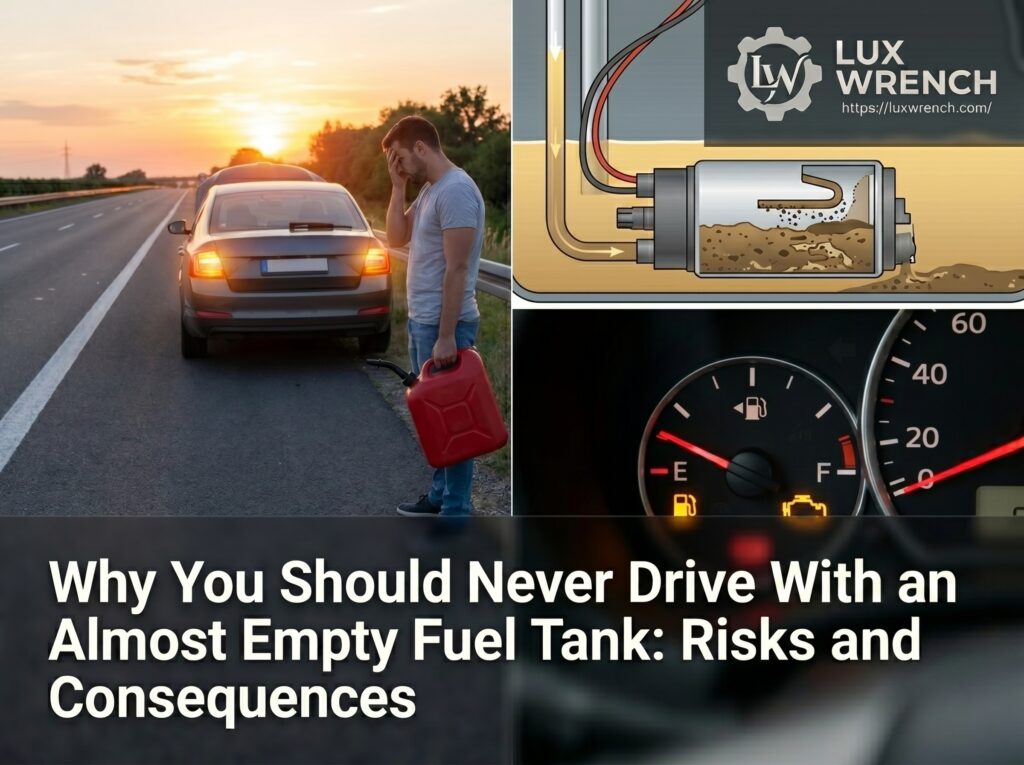
But the fuel pump has a second, vital function that few people know about: the fuel itself acts as a coolant and lubricant for the pump. The liquid surrounding the motor absorbs the heat generated by its operation and keeps it at a safe temperature. When you drive with the level extremely low or empty, the pump is no longer submerged; it begins to suck air instead of liquid, and without that bath of fuel to cool it down, it overheats rapidly.
Running the pump dry or with very little fuel causes irreversible damage to its internal motor and bearings. It significantly reduces its lifespan, often destroying it completely in a short time. Replacing a fuel pump is not cheap: it is a complex part, located inside the tank, and labor costs are high. This repair, which can easily cost hundreds of dollars, is 100% preventable simply by keeping enough fuel in the tank.
⚙️ 2. Sediment, Dirt and Contaminants Entering the Engine
Whether you use gasoline or diesel, no fuel is 100% chemically pure. Over time, and during transportation and storage, small particles of dust, rust, dirt, and heavy residues accumulate. Due to gravity, all these impurities naturally settle at the very bottom of the fuel tank, forming a layer of sediment that stays there as long as there is enough liquid above it.
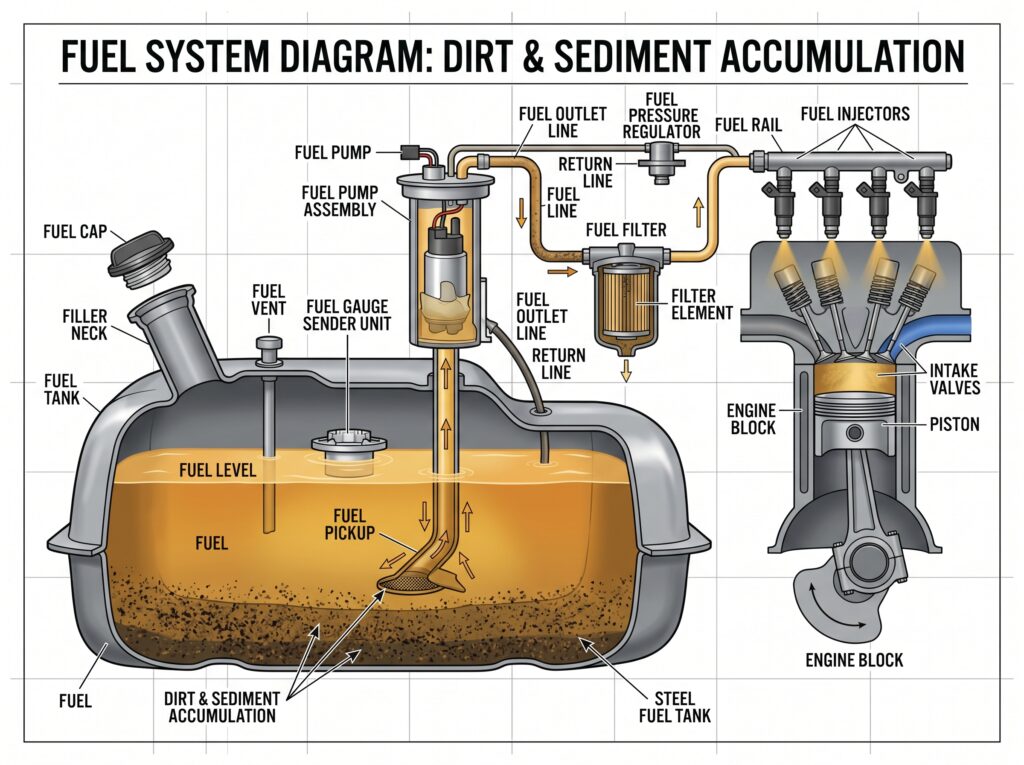
The moment your fuel level drops too low, the pump intake stops drawing clean fuel and begins to suck up all that mud, dirt, and residue that has settled at the bottom. This is exactly what you should never let happen. Once these impurities enter the system, they pass through the fuel lines, clog the filters, and worst of all, reach the fuel injectors.
Fuel injectors are precision components with extremely small holes measured in microns. Even a tiny grain of dirt can block them or alter their spray pattern. When injectors get clogged or damaged, the engine runs rough, loses power, consumes more fuel, and emits more pollution. In severe cases, these abrasive particles can even damage the cylinders and valves, leading to mechanical wear that is costly and sometimes impossible to repair without rebuilding the entire engine.
⚠️ 3. The Fuel Gauge is Only an Estimate, Not Exact
One of the biggest mistakes drivers make is trusting the fuel warning light as if it were a guarantee. The common belief is: “When the light comes on, I still have about 50 or 90 kilometers to go.” While this is a general reference given by manufacturers, it is absolutely not an exact number, and relying on it can leave you stranded on the road.
The actual distance you can drive after the warning activates depends entirely on external factors that the sensor cannot calculate perfectly:
- 🔹 Driving style: Aggressive acceleration and high speeds consume fuel much faster than economical driving.
- 🔹 Terrain: Driving uphill, on steep roads, or in mountainous areas increases consumption drastically.
- 🔹 Vehicle load: Carrying heavy weight or many passengers requires more energy and burns more fuel.
- 🔹 Traffic: Constant stopping and starting in traffic jams consumes much more than cruising steadily.
It is very common for the computer to estimate 80 km of range, but due to driving conditions, you run out of fuel after only 20 or 30 km. Trusting the light is a gamble you will eventually lose, leaving you stuck far from a gas station.
💥 4. Sudden Stalling and Damage to the Injection System
When the tank runs dry, the pump stops sending fuel and starts pumping air. This creates a condition known as “fuel starvation.” The consequences for the engine are immediate and harmful:
- 🔸 Engine Hesitation or Stalling: The car begins to jerk, lose power, or simply shut down while driving, which is extremely dangerous, especially in intersections, highways, or overtaking maneuvers.
- 🔸 Air in the System: Modern diesel engines are very sensitive. If air enters the lines, it creates bubbles that block the flow, making it very difficult or impossible to restart the car even after refueling. You often need a mechanic to bleed the system manually.
- 🔸 Injector Damage: Fuel acts as a lubricant for the internal moving parts of the injectors. Without liquid, metal parts rub against each other, causing premature wear and leaks.
- 🔸 Reduced Efficiency: Even if it doesn’t stall, running lean (too much air, too little fuel) causes the engine to run hotter and work harder than it was designed to.
Beyond mechanical damage, running out of fuel is a safety risk: you lose power steering, brake assistance, and mobility exactly when you need it most.
🛢️ 5. Long-Term Engine Performance Loss
Repeating this habit over months and years has cumulative effects that degrade your vehicle’s performance permanently. Every time you drive low, you send small amounts of dirt through the system, you overheat the pump, and you force the engine to run irregularly. Over time, this leads to:
- Gradual loss of engine power and responsiveness.
- Lower fuel economy: the car starts consuming more gas to do the same work.
- Increased emissions and failed inspections.
- Shortened lifespan of the entire fuel system.
✅ The Golden Rule: When Should You Refuel?
After seeing all these risks, the solution is simple and straightforward. Automotive engineers and mechanics agree on the best practice to protect your car: Never let the level drop below one quarter (1/4) of the tank capacity.
As soon as the indicator reaches the last quarter mark, plan your stop to refuel. This ensures:
- The fuel pump is always fully submerged and cooled, extending its life for the entire life of the car.
- You never reach the bottom layer where dirt and deposits accumulate.
- You always have a safety margin for unexpected detours or traffic.
- You protect the injectors and filters from contamination.
📹 Complete Video Explanation
Watch this video to see visually what happens inside your tank and pump when you drive with low fuel, and why this simple habit saves you thousands in repairs:
📌 Conclusion
Driving with an almost empty fuel tank is a habit that seems harmless but is actually a silent enemy of your vehicle. From destroying the fuel pump to sucking up dirt and damaging the injection system, the risks are real and the repairs are expensive. It is not about saving money; it is about avoiding costs that you can easily prevent.
Maintaining the level above the quarter mark is the simplest, cheapest, and most effective maintenance you can do. It protects your investment, ensures your safety, keeps your engine running smoothly, and guarantees that your vehicle serves you reliably for many years. Prevention is always better, and cheaper, than repair.