Engine Oil: Complete Guide — Functions, How to Check, Add, and Risks of Wrong Levels

Engine oil is often called the “blood of the engine,” and for good reason. It is the most important fluid in your vehicle, responsible for keeping every moving part protected, clean, and working smoothly. Without it, or with it in poor condition, an engine would seize up and be destroyed in just a few minutes of operation. Understanding exactly what it does, how to check it correctly, how to add it, and —most importantly— what happens if you make a mistake with the level, is essential knowledge for any driver who wants to avoid expensive repairs and keep their car reliable for years.
🔧 What Does Engine Oil Actually Do?
Its job goes far beyond just “lubricating.” It performs 5 vital functions simultaneously:
- ✅ Lubrication: Creates a microscopic film between metal parts (pistons, cylinders, crankshaft) so they slide instead of grinding against each other. This eliminates friction and prevents wear.
- ✅ Cooling: Carries away excess heat generated by combustion and friction, helping the cooling system keep the engine at the right temperature.
- ✅ Cleaning: Contains detergents that trap dirt, soot, and metal particles, keeping them suspended in the fluid so they don’t form sludge or deposits inside the engine.
- ✅ Sealing: Helps seal the small gap between pistons and cylinder walls, ensuring maximum compression and power.
- ✅ Protection: Contains additives that prevent corrosion and neutralize acids produced during combustion.
Because it works so hard, oil degrades over time: it loses its viscosity, gets dirty, and loses its protective properties. That is why regular checks and changes are non-negotiable.
📏 How to Check Engine Oil Correctly (Step-by-Step)
Checking the oil seems simple, but doing it wrong leads to wrong readings and bad decisions. Follow this exact method to be 100% accurate:
✅ PREPARATION (CRITICAL STEPS)
1. Park on perfectly flat ground: If the car is tilted, the oil shifts to one side and the reading will be wrong.
2. Engine MUST be cold: If you just drove it, wait at least 10–15 minutes. Hot oil expands and also takes time to drain back down into the pan. Checking it hot or right after turning off gives a false low level.
- Pull out the dipstick: Locate the handle (usually yellow or orange). Pull it all the way out.
- Clean it completely: Wipe it with a clean cloth or paper towel until it is dry and you can see the metal clearly. This removes old oil that distorts the mark.
- Insert fully: Put it back in all the way until it seats. Do it slowly and straight.
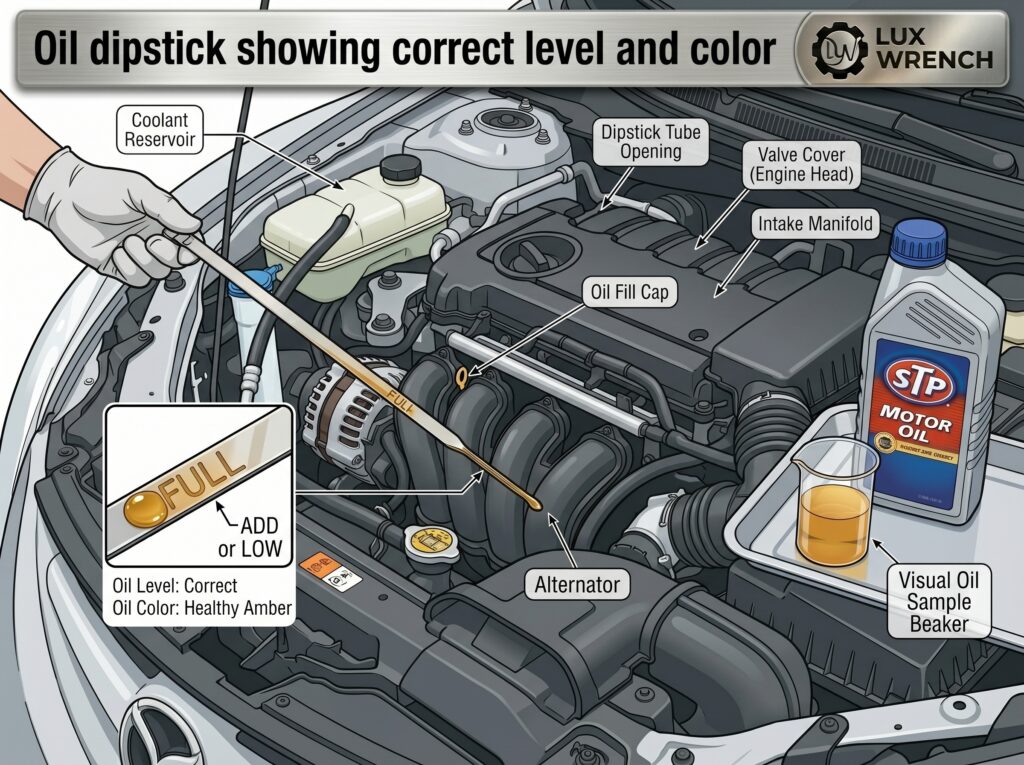
- Read the level: Pull it out again. The oil mark should be between the MIN and MAX lines. Ideally, it should be close to the MAX mark, but never above it.
🔎 Also Check the Condition and Color
The level is not the only thing that matters. Look at the oil itself:
- 🟡 Golden / Amber / Light Brown: Fresh, clean, good condition. Perfect.
- 🟤 Dark Brown / Opaque: It has done its job, is getting old, needs changing soon.
- ⚫ Black / Thick / Sludgy: **DANGER.** It is completely degraded, dirty, and has lost all properties. Change it immediately or you risk engine damage.
- 💧 Milky / Creamy color: **SERIOUS PROBLEM.** This means coolant is mixing with oil, usually due to a blown head gasket. **Do not drive the car.** Repair it immediately.
📱 Modern Cars: Electronic Sensors vs. Dipstick
Many new vehicles no longer have a physical dipstick; they use electronic sensors that show the level on the dashboard screen or menu. While convenient, this has pros and cons:
- ✅ Advantage: Very precise, considers temperature, and alerts you automatically.
- ❌ Disadvantage: YOU CANNOT SEE THE OIL. You only know the level, but you cannot check the color, smell, or texture. You won’t know if it is dirty or contaminated until it’s too late.
Rule: If your car only has a sensor, follow the service schedule strictly. Do not extend oil change intervals, because you lose the visual check that warns you early.
➕ How to Add Oil Safely and Correctly
If your level is below the middle or near MIN, you must add oil. But **DO IT RIGHT**, because mistakes here are expensive.
⚠️ FIRST: Choose the RIGHT Oil
Never buy just “any oil.” You must use exactly the viscosity and specification written in your owner’s manual (e.g., 5W-30, 0W-20, API SN, ACEA C3, etc.). Using the wrong grade leads to poor lubrication, high consumption, or engine failure. Synthetic oil is always better and lasts longer than conventional.
📝 Step-by-Step Adding Process
- Engine COLD and flat ground: Same rule as checking.
- Open the filler cap: Located on top of the valve cover, usually marked “OIL”. Clean the area around it before opening to prevent dirt from falling in.
- Add LITTLE by LITTLE: This is the most important rule. Do NOT pour the whole bottle. Add about ¼ or ½ liter at a time. Wait 2 minutes for it to drain down to the pan.
- Re-check level: Use the dipstick or the menu. Repeat until you reach the correct level.
- Close tight: Make sure the cap is screwed on properly.
❌ THE BIG DANGER: What Happens If You Overfill (Too Much Oil)?
Most people worry about running low, but OVERFILLING IS WORSE AND MORE EXPENSIVE. Many drivers add too much thinking “more is better,” but it is a catastrophic mistake.
💥 Why is it dangerous?
Oil needs space to flow. If you fill above the MAX line, the oil level rises high enough that the rotating crankshaft hits the oil pool directly. This is what happens:
- 🌪️ Oil becomes FOAM: The crankshaft beats the oil like an egg beater, mixing air into it. Oil turns into bubbles/foam.
- ⚠️ Lubrication FAILS: Air bubbles cannot lubricate. Pumping foam means metal parts rub together without protection. **This destroys the engine in minutes.**
- 🔧 High Pressure: Pressure builds up inside, blowing out seals, gaskets, and damaging the oil pump.
- 🔥 Overheating & Smoke: The engine runs hot, burns oil, and blue smoke comes out the exhaust.
Consequence: Bent connecting rods, broken pistons, seized engine. **Repair cost: $2,000 – $5,000+ USD.**
⚠️ IF YOU OVERFILLED: Do NOT start the engine. You must drain the excess immediately via the drain plug or suction pump. Do not drive it even one meter.
📉 Risks of Low Oil Level
Running below MIN is also dangerous, obviously:
- Oil pump sucks air instead of oil.
- Top parts of the engine (camshafts) run dry.
- Overheating and rapid wear.
- Total failure if the level drops too low.
📹 Video Guide: How to Check and Add Oil Correctly
Watch this visual guide to see exactly where to look and how to do it safely:
📌 Conclusion
Engine oil maintenance is the simplest, cheapest, and most effective way to protect your investment. It takes 2 minutes to check, but it saves you thousands in repairs.
Remember the golden rules:
✅ Check ONLY when cold and on flat ground.
✅ Keep level between MIN and MAX (never above!).
✅ Use ONLY the oil grade specified by the manufacturer.
✅ Change it before it turns black and thick.
✅ If color turns milky white, STOP and check immediately.
By following these steps, you ensure your engine stays healthy, powerful, and lasts hundreds of thousands of kilometers without major issues. Prevention is always cheaper than repair.