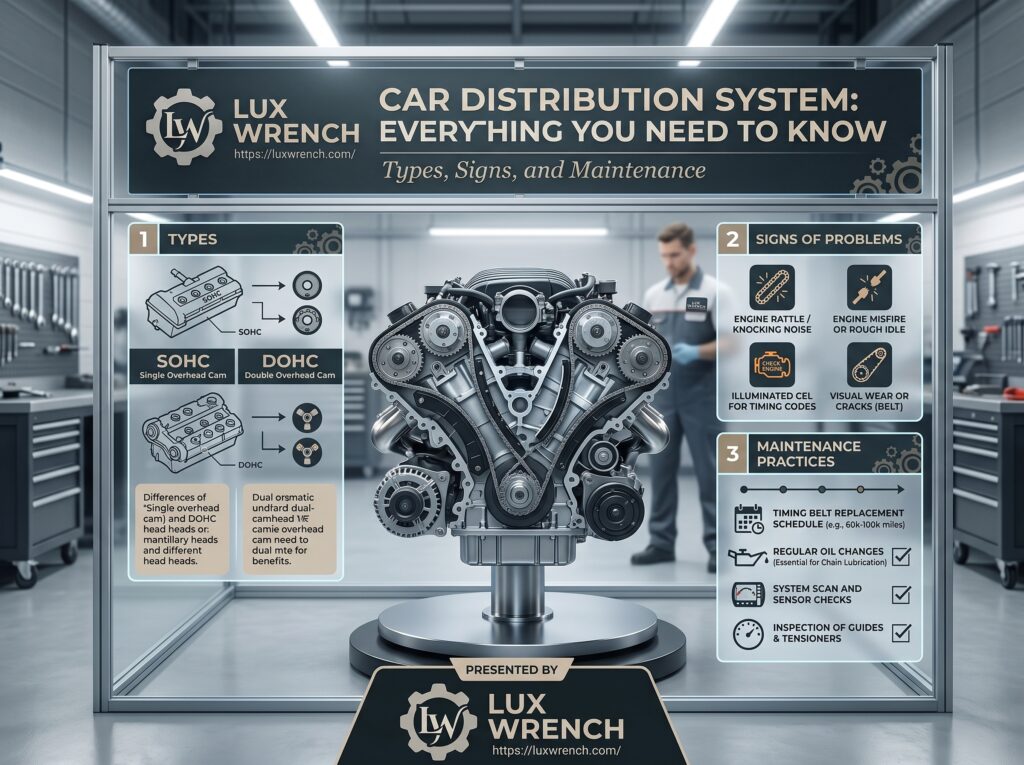
Car Distribution System: Everything You Need to Know — Types, Signs, and Maintenance
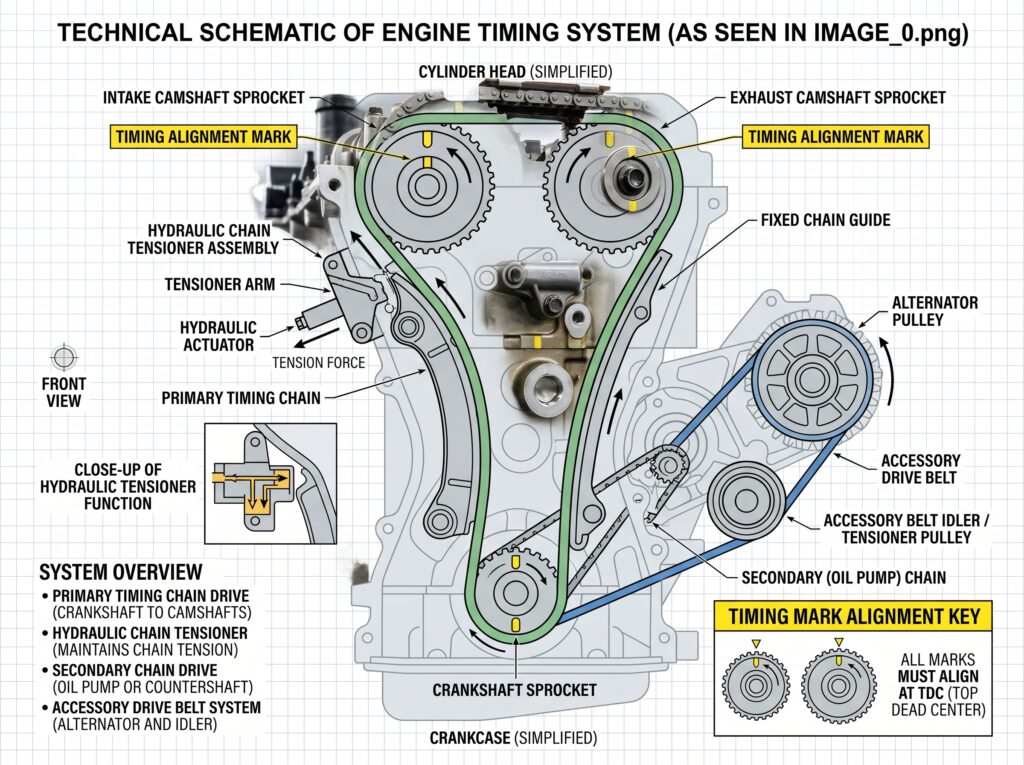
The distribution system, widely known as the timing system, is without a doubt the most critical component inside your vehicle’s engine. It acts as the brain and the conductor at the same time, ensuring that every moving part moves exactly when it should. Its main function is to perfectly synchronize the rotation of the crankshaft and the camshafts, guaranteeing that intake and exhaust valves open and close at the precise millisecond, and that pistons move in perfect harmony with the combustion cycle. Without this precise coordination, the engine simply cannot work, and worse, parts will collide and destroy each other. Proper timing is essential for efficiency, power, fuel economy, and longevity. Neglecting maintenance or ignoring warning signs here leads to catastrophic damage and repair costs that often exceed the value of the car itself. In this complete guide, we explain how it works, the different types available, what signs to watch for, and exactly how to maintain it to avoid disasters.
🔍 What is the Car Distribution System Exactly?
Think of the distribution system as a precise mechanical link between the lower part and the upper part of the engine. It connects the crankshaft (which receives power from the pistons) to the camshafts (which control the valves). But it is not just a simple belt or chain; it is a complete kit formed by the main element, tensioners, idler pulleys, guides, and in many cases, it also drives the water pump. All these parts work together to keep the synchronization accurate, even under high temperature, high speed, and intense vibration.
When everything works correctly, combustion happens at the perfect moment, performance is optimal, and wear is minimal. However, if this synchronization is lost — even by just a few millimeters — the engine loses power, consumes more fuel, emits more pollutants, and runs roughly. If it breaks completely, the pistons crash into the open valves, bending them, damaging the cylinder head, and often breaking the engine block. This is why experts say: the distribution system is not a repair, it is a prevention.
⚙️ Main Types of Distribution Systems
Depending on the manufacturer, the year, and the engine design, there are three main types of systems. Each has its own characteristics, durability, and maintenance rules. Knowing which one you have is the first step to taking care of it correctly.
1. Belt-Driven System: The Most Common
This is the system found in the majority of modern vehicles. It uses a flexible belt made of high-strength reinforced rubber, with teeth designed to fit perfectly into the gears. It is quiet, lightweight, and highly precise. However, rubber degrades over time due to heat, oil, and tension.
Maintenance Rule: It must be replaced strictly following the manufacturer’s schedule, usually between 90,000 and 120,000 kilometers, or every 4 to 5 years, whichever comes first. Important: Time is as important as mileage; rubber ages even if the car is parked. When replacing the belt, you must always change the tensioner, rollers, and often the water pump. Never reuse old parts. If it breaks, the damage is almost always irreparable.
2. Chain-Driven System: Durability and Strength
Instead of rubber, this system uses a metal chain, similar to a bicycle chain but much stronger and more precise. It is used in many modern cars, diesel engines, and high-performance vehicles. Its great advantage is durability: it is designed to last the entire life of the engine, often exceeding 180,000 or 200,000 kilometers without needing replacement.
Maintenance Rule: Although it does not need periodic replacement, it is not maintenance-free. Over time, the chain can stretch, the tensioner can lose pressure, or the plastic guides can wear out or break. You must pay attention to noises and perform inspections. If neglected, a stretched chain can jump teeth, losing timing and causing the same damage as a broken belt.
3. Gear-Driven System: Maximum Reliability
Less common in passenger cars today, this system uses a set of robust interlocking gears to transfer movement. It is extremely reliable, very strong, and does not slip or stretch. It was very common in older vehicles, trucks, and industrial engines.
Maintenance Rule: It is practically maintenance-free and very durable. However, it is noisier and heavier. Repairs are complex and expensive because the parts are large and labor-intensive to replace. It is very rare for this system to fail unless there is a severe lack of lubrication.
⚠️ Warning Signs: When Your System Needs Attention
Before a catastrophic failure, the engine almost always sends clear signals. Recognizing these signs early can save you thousands of dollars and a lot of trouble. If you notice any of these symptoms, do not wait: check the distribution system immediately.
- 🔧 Unusual Engine Noises: This is the most common warning. You may hear a rattling, clicking, or slapping sound coming from the front of the engine, especially when starting up or idling. In chain systems, this noise indicates the chain has stretched or the tensioner is failing. In belt systems, it may mean the belt is dry, cracked, or a bearing is seizing.
- 💨 Smoke from Exhaust: If you see excessive smoke — white, black, or blue — it can be a sign of bad timing. If valves open too early or too late, combustion is incomplete, fuel is wasted, and the engine does not breathe correctly. This often happens when the belt or chain has skipped a tooth.
- 🚗 Difficulty Starting or Stalling: When synchronization is wrong, compression is lost. The car becomes very hard to start, takes a long time to turn on, or stalls constantly when you release the accelerator. It feels like the engine has no strength or will to keep running.
- 🛢️ Oil or Coolant Leaks: Leaks near the timing cover are dangerous. Oil or coolant dripping onto the belt destroys it quickly, making it slip or break. If you see stains or wetness in that area, fix the leak and inspect the system immediately.
- 📉 Loss of Performance: The car feels sluggish, does not accelerate well, consumes much more fuel than usual, or vibrates excessively. These are signs that the timing is off, and the engine is working against itself.

🛡️ Maintenance and Replacement: Best Practices
Prevention is the only strategy that works here. There is no repair cheaper or smarter than maintenance. Follow these 5 golden rules to keep your distribution system 100% safe and reliable:
- Follow the Schedule Exactly: Do not extend the recommended time or mileage. If the manual says 90,000 km, change it at 85,000. If it says 5 years, change it at 4. The risk increases exponentially as time passes.
- Always Change the Complete Kit: Never change just the belt or just the chain. Always replace the tensioner, idler pulleys, guides, and seals at the same time. These parts wear out at the same rate. If you leave an old tensioner, it can fail tomorrow and ruin your new belt. On belt systems, always change the water pump too, since labor is the same and the pump usually fails right after the belt.
- Use Only Quality Parts: This is not the place to save money. Buy original equipment (OEM) or recognized premium brands. Cheap belts or chains often have poor materials, stretch easily, or break prematurely. The difference in price is minimal compared to the cost of a damaged engine.
- Trust Specialized Hands: Replacing the timing system requires precision, specific tools, and exact knowledge of alignment marks. If the marks are off by even one tooth, the engine will not work well or will break. Make sure your mechanic is experienced in this specific task.
- Monitor Oil and Coolant: Good lubrication and cooling protect the system. Oil leaks are the number one enemy of rubber belts. Keep levels correct and fix leaks immediately.
📹 Video Guide: How the Timing System Works
Watch this video to understand visually how synchronization works and why maintenance is so critical:
📌 Conclusion: The Heart of Your Engine
The distribution system is much more than just a belt or a chain; it is the mechanism that gives life and order to your engine. Whether you have a belt, chain, or gear system, the principle is the same: precision and care are non-negotiable. Ignoring maintenance, delaying replacements, or ignoring warning signs is a gamble you will always lose.
Recognizing noises, smoke, starting issues, or leaks, and acting on them immediately, is the best way to protect your investment. By following the manufacturer’s schedule, changing the complete kit, using quality parts, and keeping fluids in perfect condition, you ensure that your engine runs smoothly, efficiently, and safely for hundreds of thousands of kilometers.
Remember: Replacing the timing system costs money, but a broken engine costs a fortune. Prevention is always the cheapest and smartest option.