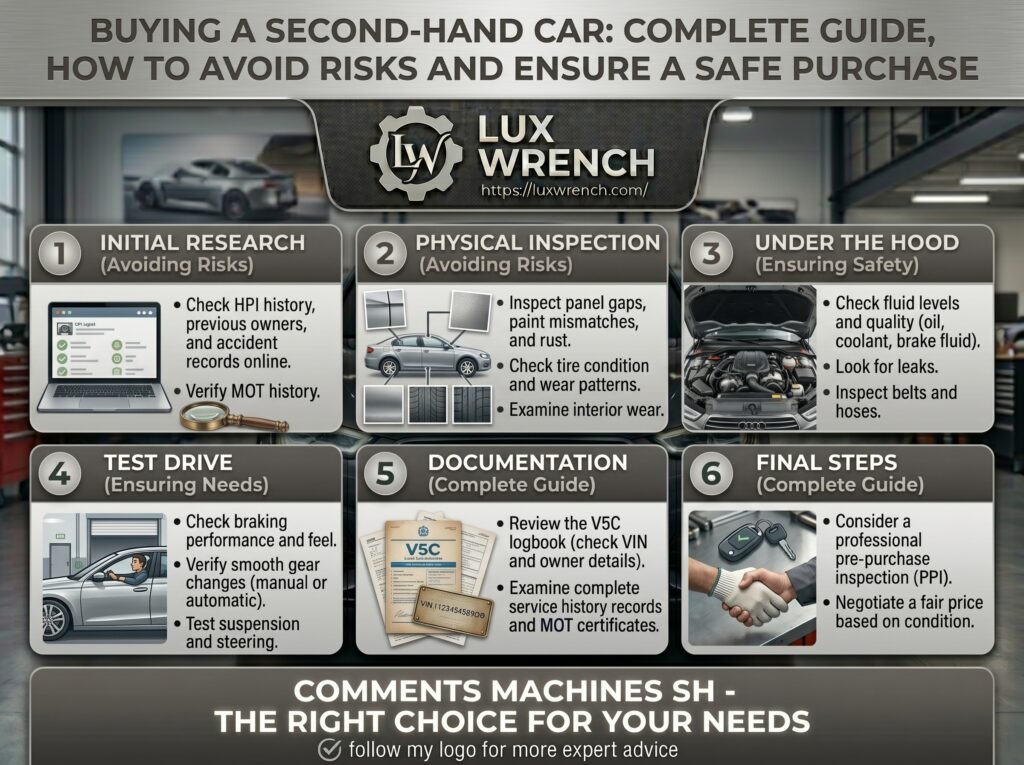
Buying a Second-Hand Car: Complete Guide, How to Avoid Risks and Ensure a Safe Purchase

Purchasing a second-hand car is one of the smartest financial decisions you can make: you avoid the biggest depreciation hit that happens the moment a new car leaves the dealership, you get more features for the same budget, and you can access models that are no longer sold new. However, it is also a process full of risks, uncertainties, and possible scams. From hidden mechanical defects to falsified mileage, altered documents, or cars involved in accidents, the risks are real and can turn a good deal into a nightmare.
In this complete, professional, and detailed guide, we explain everything you need to know to buy safely, what steps to follow, what to check, what documents to demand, and how to ensure that the vehicle you are taking home is reliable, safe, and worth every penny you pay for it.
⚠️ Main Challenges and Risks When Buying Used
The main reason why many people are afraid to buy a used car is the lack of transparency. Unlike new vehicles, which come with a guarantee and known history, a used car has a past, and the seller does not always tell you everything. These are the most common problems you may face:
- 🔧 Hidden Mechanical Defects: Problems with the engine, gearbox, suspension, or brakes that are not visible at first glance but will break down shortly after purchase, costing hundreds or thousands in repairs.
- 📉 Modified or Falsified Mileage: One of the most common scams. Turning back the odometer to make the car look newer and more valuable. A car with 200,000 km sold as having 80,000 km will fail very soon.
- 📄 Irregular Documentation: Cars with pending fines, unpaid taxes, legal holds, or even stolen vehicles that you could lose immediately.
- 💥 Accident or Flood History: Vehicles that were seriously damaged, poorly repaired, and are unsafe to drive or have structural weaknesses.
- 🛡️ Lack of Warranty: Private sales are almost always “as is,” meaning once you pay, you have no right to claim anything if it breaks the next day.
All these factors generate distrust and stress, but the good news is that all these risks are avoidable if you follow a clear method and know exactly what to inspect.
✅ Step 1: Verify the Documentation and Legal Status
Before even looking at the engine or tires, the first thing you must do is verify the papers. A car with bad paperwork is not worth anything, no matter how good it looks. Here is the checklist:
- Registration Certificate: Check that the chassis number (VIN) and engine number match exactly what is written on the document and what is stamped on the car plate. No erasures or modifications allowed.
- Owner’s Identity: Make sure the person selling it is the actual owner. If it is a representative, ask for a notarized authorization.
- Service History Book: This is the most valuable document. If it has all the stamps and dates from official workshops, you know the car was well maintained. If it is blank or lost, be very careful.
- Tax and Fine Status: Verify that there are no outstanding debts or legal restrictions on the vehicle. You can check this through official vehicle registration databases.
- Technical Inspection Report: Ensure it passed the last mandatory inspection and that all systems were approved.

🔍 Step 2: Visual and Exterior Inspection
Now it is time to look at the car itself. Do this in daylight and on a dry day; never in the dark or under a roof where you cannot see details. Look for these signs:
- Bodywork and Paint: Look carefully at the color and shine. If one part is slightly different, or if you see waves or irregularities in the paint, it means it was repainted due to an accident. Check the gaps between doors, hood, and fenders: they should all be equal and symmetrical.
- Glass and Lamps: Check that all glass has the same manufacturer’s mark and date. If a windshield or headlight is different, it was replaced due to impact.
- Tires: They must all be the same brand and model. Check the wear: if they are worn more on one side, the alignment or suspension is damaged. If they are very old (more than 5-6 years), you will have to change them soon.
- Leaks: Look under the car. There should be no stains of oil, coolant, or liquid on the floor. A clean floor is a good sign.
🛋️ Step 3: Interior and Comfort Inspection
The interior tells you exactly how the car was treated and the real use it had. Even if the mileage says low, the wear inside never lies.
- Steering Wheel and Seats: These are the parts that wear out the most. If the steering wheel is shiny, worn, or torn, or if the driver’s seat is sunken or damaged, the car has many kilometers, even if the meter says otherwise.
- Dashboard and Controls: Turn the key to the ON position (without starting). All warning lights must turn on. When you start the engine, they must all turn off immediately. If any stays on, there is a fault stored in the computer.
- Electronics: Test absolutely everything: lights, indicators, windshield wipers, air conditioning (cold and hot), windows, locks, radio, screens, sensors… Everything must work perfectly. Repairs to electronic systems are very expensive.
- Upholstery and Odors: Look for water stains or mold under the mats and seats. A smell of humidity or wet carpet means the car was flooded: do not buy it, it is dangerous and will give you endless problems.
🔧 Step 4: Mechanical Check: Engine and Systems
This is the most critical part. If you do not know much about mechanics, bring a trusted mechanic with you; paying for an inspection now saves you thousands later. Here is what to look for:
Engine Cold Start
Do not let the seller warm up the engine before you arrive. You must see it start cold. A healthy engine starts immediately, sounds smooth and regular, and does not make strange noises. If it takes time to start, shakes, or makes loud metallic sounds, it has problems.
Smoke and Exhaust
Look at the exhaust pipe:
– 🟢 White vapor: Normal on cold days, disappears quickly.
– 🔵 Blue smoke: It burns oil. Serious problem with rings or valves. Very expensive repair.
– ⚫ Black smoke: Too much fuel, clogged filters, or injection problems.
– ⚠️ Thick white smoke that does not stop: Coolant entering the engine. Blown gasket or cracked head: DO NOT BUY.
Transmission and Clutch
Test all gears. They must enter smoothly, without crunching, resistance, or jumps. The clutch pedal must have consistent pressure. If it feels soft, hard, or slips when accelerating, the clutch is worn out.
Suspension and Brakes
Push down on each corner of the car. It should bounce once and stop. If it bounces many times or makes noise, the shock absorbers are dead. When driving, the car should not pull to one side, and the steering wheel should be centered. Brakes must stop the car firmly without vibration or noise.
🚗 Step 5: The Test Drive: Essential and Non-Negotiable
Never buy a car without driving it yourself. Drive it for at least 15-20 minutes, on different roads: slow, fast, curves, and bumps. Pay attention to:
- Alignment: Does it go straight without holding the wheel?
- Vibrations: Any vibration in the steering wheel or seat means unbalanced wheels or damaged parts.
- Noise: Listen for hums, clicks, or rattles that should not be there.
- Power: Does it accelerate smoothly and respond well?
- Temperature: Watch the gauge. It must stay exactly in the middle, never go up or down suddenly.
🛡️ How to Buy Safely: Professional Inspection
The safest way to buy is to treat the purchase as a professional process. The best buyers and dealers always follow these rules:
- Request a Full Diagnostic: Connecting the car to a scanner reveals hidden faults that do not turn on warning lights. It is cheap and essential.
- Check the History: Use official databases to verify mileage, accidents, and service records. A car with a documented history is worth much more and is much safer.
- Independent Inspection: Take the car to a neutral workshop, not one recommended by the seller. Let them lift it up and check the bottom, structure, and mechanics.
📹 Complete Video Guide: What to Check Before Buying
Watch this video where we show you visually every point we mentioned, so you do not miss a single detail:
📌 Conclusion
Buying a second-hand car does not have to be stressful or dangerous. In fact, it is the smartest way to buy a vehicle, as long as you do it with information, patience, and following the right steps. The risks exist, but they are all detectable and avoidable.
By verifying documents, inspecting the body, checking the mechanics, and taking it for a test drive, you eliminate 99% of the problems. Always remember: the cheapest car is not the best deal; the best car is the one that is in good condition and has a clear history.
With this guide, you have all the tools to buy safely, avoid scams, and take home a vehicle that will serve you reliably for years, saving you money and giving you peace of mind.