Periodic Technical Inspection (ITP): Complete Guide to Pass Easily on the First Try
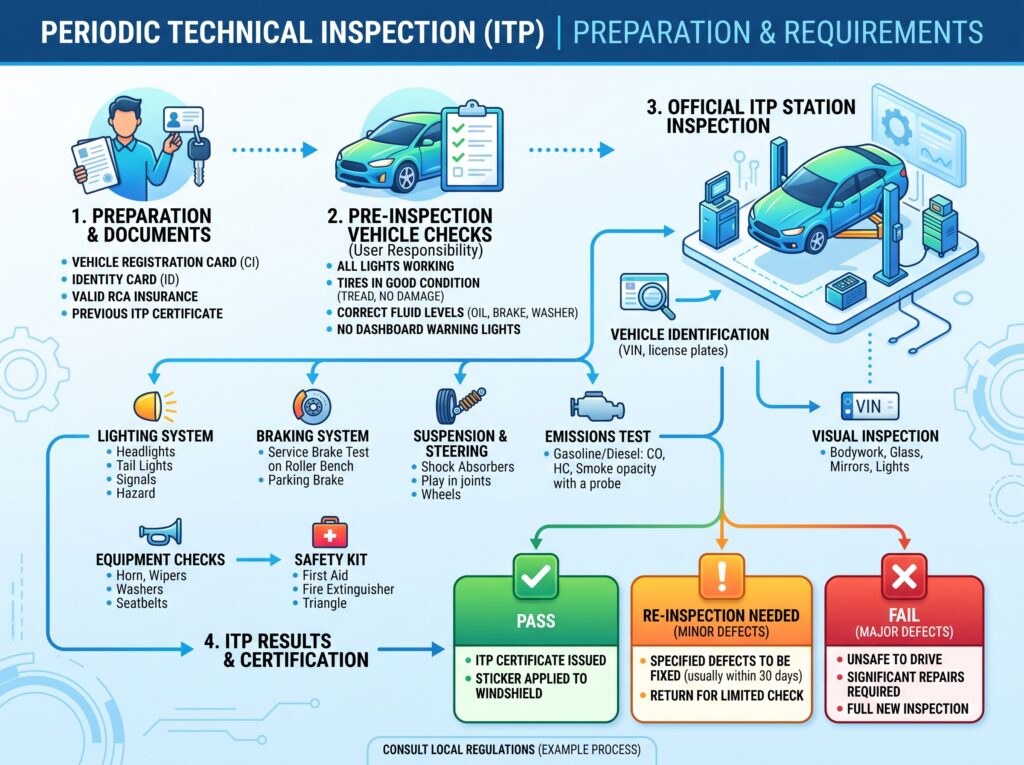
The **Periodic Technical Inspection (ITP)** is much more than just a legal requirement or a bureaucratic procedure. It is the most effective tool to ensure that your vehicle is safe, functional, and does not pollute more than allowed. Its main purpose is to verify that the car meets all safety and environmental standards established by law. Passing this inspection is mandatory for every vehicle, and failing it or letting it expire leads to fines, legal penalties, and even the immobilization of the car. However, many drivers feel nervous or confused about what exactly is checked and how to prepare. The secret to success is simple: **preparation**. If you know what they look for and fix small problems beforehand, you will pass easily on the first visit. In this complete guide, we explain everything you need to consider, step by step, to arrive confident, calm, and ready to get your certificate.
📅 1. Scheduling and Planning: Do Not Wait Until the Last Day
The first mistake many people make is waiting until the day before expiration to make the appointment. This is risky and unnecessary. Good planning is half the work done.
- ✅ Check Your Validity: Look at your current certificate. Mark the expiration date on your calendar. Remember that you can go up to 30 days *before* the date without losing days of validity. Do not wait until it expires; driving with expired ITP is illegal and fined heavily.
- ✅ Book in Advance: Inspection centers get very busy near the end of the month or season. Call or book online at least 2–3 weeks early to choose a day and time that suits you. This avoids stress and rushing.
- ✅ Know the Rules: The frequency depends on the age and type of vehicle. Usually, new cars need it every 2 years, and older ones every year. Commercial vehicles or taxis usually need it every 6 months. Know your schedule and stick to it.
Planning ahead ensures you are always legal and avoids unnecessary penalties.
📄 2. Documentation: Everything Must Be in Order
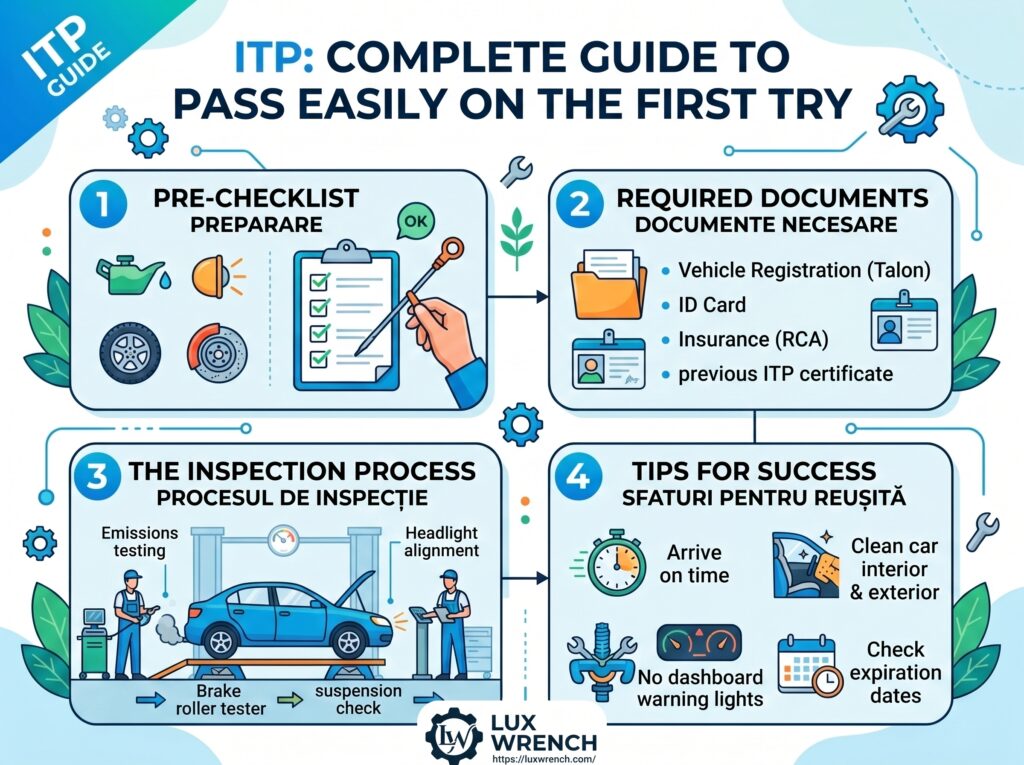
Before even looking at the car, the inspector will ask for your papers. If something is missing or wrong, they will not start the inspection. Have these documents ready and organized:
- ✅ Vehicle Registration Certificate: This is the official paper that proves the car is registered and identifies the owner. It must be original and legible.
- ✅ Valid RCA Insurance: Proof of current civil liability insurance. It must be active and cover the exact day of the inspection. If your insurance expires tomorrow, renew it first.
- ✅ Personal Identification: Your ID or passport. If someone else takes the car, they must carry their own ID and authorization.
- ✅ Vehicle Identity Sheet / Technical Card: This document contains the technical data of the car: weight, engine size, emissions, etc. It must match exactly what is written in the system.
- ✅ Modifications Approval: Have you changed the wheels, suspension, exhaust, or lights? Any modification that changes the original specifications must be legally approved and noted in the documents. If you have changes without papers, you will fail immediately.
Tip: Put all these in a plastic folder so you do not lose them or damage them on the way.
🔍 3. Pre-Inspection Check: What to Verify Yourself
You do not need to be a mechanic to check the most basic things. These are the items that fail most often and are very easy to fix. Go through this list carefully before leaving home:
✅ Lighting and Signaling: The Most Common Failure
More than 40% of rejections are due to lights not working correctly. Do this test with a friend or family member:
- Turn on position lights and low beams (both sides, same height).
- High beams and front fog lights.
- Brake lights: press the pedal — both must shine bright.
- Turn signals front and rear: check they flash at the right speed.
- Reverse lights and hazard lights.
- License plate light: it must illuminate the plate clearly.
Replace any burnt bulb immediately. It costs pennies and saves you from rejection.
✅ Brakes: Safety First
Brakes are the most critical safety system. Check:
- Pedal feels firm, not soft or spongy.
- Car stops straight without pulling to one side.
- Handbrake holds the car firmly on a slope.
- No leaks or wet spots near the wheels or under the car.
✅ Tires: Legal and Safe
Tires are the only contact with the road. They are checked very strictly:
- Tread Depth: Minimum legal limit is usually 1.6 mm. If they are worn below this, change them. If you can see the wear bars, they are illegal.
- Condition: No cuts, cracks, bulges, or objects stuck in the rubber. Sidewalls must be perfect.
- Pressure: Adjust to manufacturer’s recommendation. Incorrect pressure alters measurements.
- Same Size: All four tires must be the same size and type. Do not mix radial and diagonal tires.
✅ Suspension and Steering
Push down each corner of the car; it should bounce back once and stop. No strange noises, creaks, or looseness when turning the wheel. Steering must be precise and return to center easily.
✅ Emissions and Exhaust
Black, blue, or white smoke coming out of the pipe means you will fail. Check that the exhaust is complete, fixed firmly, and has no holes or leaks. A noisy or broken pipe is an automatic rejection.
⚙️ 4. Technical Condition: Fluids and Mechanics
Now look under the hood and under the car. These details show you take care of the vehicle and prevent mechanical failures:
- Engine Oil: Check level and condition. It should be between MIN and MAX, not black or dirty. Change it if it is time. Low oil damages the engine and affects emissions.
- Coolant and Brake Fluid: Reservoirs must be at correct levels. No leaks, no wet stains, no cracks in hoses. If you see fluid under the car, find out where it comes from and fix it.
- Filters: Air, fuel, and oil filters must be clean. A clogged air filter increases pollution and makes the engine run bad.
- Belts and Hoses: Check for cracks, wear, or looseness. Everything must be tight and in place.
- Engine Operation: Start it cold. It should start easily, run smoothly, idle steadily, and not make metallic noises or vibrations.
🧹 5. Cleanliness and Order: It Matters More Than You Think
It may seem secondary, but cleanliness is part of the evaluation. A dirty car suggests lack of maintenance, and inspectors need to access components easily.
- Exterior: Wash the car, especially windows, mirrors, lights, and license plate. Everything must be visible and clear.
- Interior: Remove all unnecessary objects, trash, or heavy items. Vacuum carpets and seats. Make sure the handbrake, pedals, and seat belts work freely. Seat belts must lock and retract perfectly.
- Engine Bay: It does not need to be shiny, but it should not be covered in oil or thick dirt that hides leaks or cracks.
- Trunk: Check you have the mandatory safety kit: warning triangle, reflective vest, spare wheel or repair kit, and tools. Everything must be there and in good condition.
🔧 6. Professional Pre-Inspection: The Smartest Investment
If you are not sure, or if your car is older, or if you want total peace of mind: **go to a mechanic for a pre-check**. This is a service where they do exactly the same tests as the official station, but inform you privately. They will check brakes, emissions, suspension, alignment, and lights. They tell you exactly what to fix before you pay for the official inspection. This small investment guarantees you pass on the first try and saves you time and money in re-inspections.
📹 Video Guide: Visual Preparation Tips
Watch this video to see exactly how to prepare and what they check during ITP:
📌 Conclusion: Preparation is the Key to Success
Passing the **Periodic Technical Inspection (ITP)** is not a lottery; it is the result of good maintenance and careful preparation. It is not there to punish you, but to ensure that every car on the road is safe and does not harm the environment.
Follow these steps: schedule on time, gather all documents, check lights and tires, verify fluids and mechanics, clean the car, and ask for professional help if needed. Doing this transforms a stressful procedure into a simple, fast, and successful visit.
Remember: a car that passes ITP is a safe car, a reliable car, and a car that preserves its value. Taking care of these details is taking care of your safety and your investment. Go prepared, and you will leave with your certificate in hand and total peace of mind.