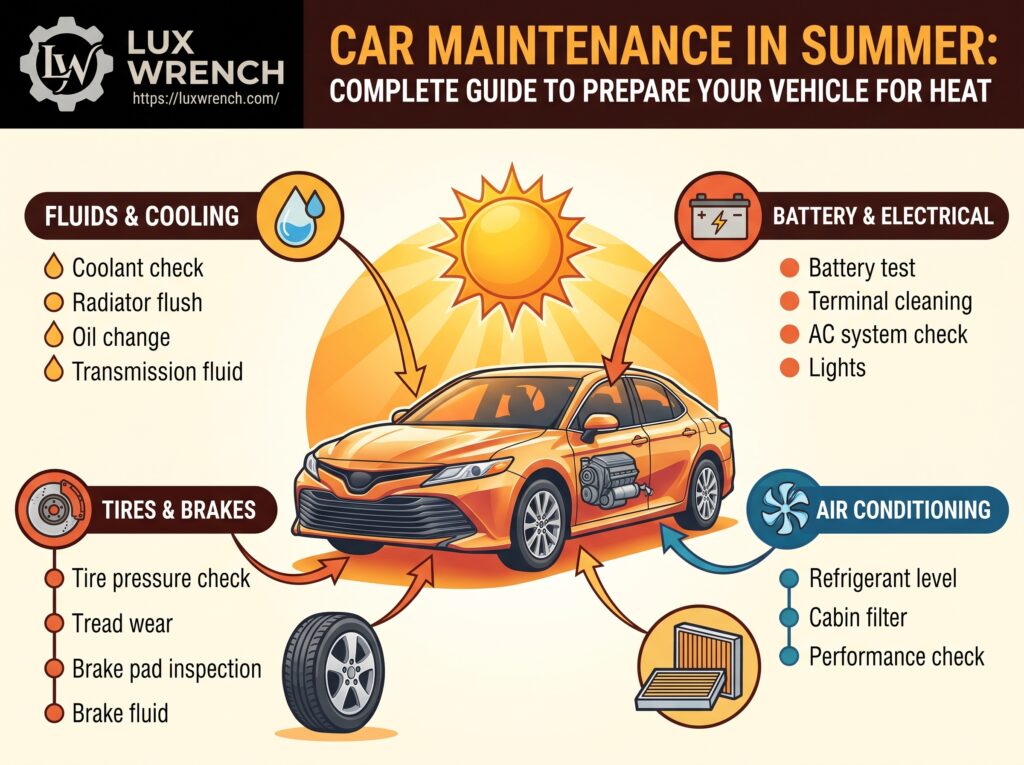
Car Maintenance in Summer: Complete Guide to Prepare Your Vehicle for Heat

When temperatures start rising and vacation season approaches, the last thing any driver wants is to deal with car problems during a trip or while enjoying the holidays. High heat, intense sun, and long journeys put extra stress on every component of your vehicle. Heat can negatively affect fluids, rubber parts, batteries, tires, and the engine itself, leading to unexpected breakdowns, expensive repairs, and even safety risks. That is why performing **car maintenance in summer** is not just a recommendation — it is essential. Proper preparation ensures your vehicle runs smoothly, efficiently, and safely regardless of how high the temperature goes. In this complete guide, we explain exactly what parts you must check, why they are important, and how to keep your car in perfect condition all season long.
❄️ Air Conditioning System: Stay Cool and Comfortable
Driving in extreme heat with a malfunctioning air conditioning system is not just uncomfortable; it can be exhausting and even dangerous. High temperatures inside the cabin cause fatigue, dehydration, loss of focus, and irritability, increasing the risk of accidents. A good AC system is vital for safety and well-being. Before the heat wave arrives, check these points:
- ✅ Cooling Capacity: Turn it on and verify that it blows cold air quickly and consistently. If it takes too long or never gets cold enough, you may have a leak or compressor problem.
- ✅ Refrigerant Level: The gas inside the circuit does not consume itself, but it can escape through small holes or loose connections. Low level is the most common cause of failure. Recharge it only after finding and fixing leaks.
- ✅ Cabin Filter: A dirty or clogged filter reduces airflow, creates bad smells, and forces the system to work harder. Replace or clean it every year to ensure fresh, clean air and good flow.
A well-functioning AC keeps everyone inside happy, alert, and safe. Do not wait until the hottest day of the year to test it.
🛢️ Engine Oil: Essential Protection Against Overheating
Engine oil is the lifeblood of the motor. Its main job is to lubricate all internal moving parts, but it also plays a huge role in cooling down the hottest areas. In summer, the engine works harder, runs hotter, and oil degrades much faster than in winter. Old or poor-quality oil becomes thin, loses its properties, and cannot protect properly. To avoid catastrophic damage:
- ✅ Check Level Frequently: Heat expands fluids, but consumption also increases. Check the level at least once a month and before long trips. Keep it between the MIN and MAX marks.
- ✅ Change It On Time: If the oil looks dark, thick, or dirty, or if you are approaching the recommended mileage, change it immediately. In hot climates, it is often better to change it a little earlier than usual.
- ✅ Choose the Right Viscosity: Use the grade recommended by the manufacturer. In very hot weather, a slightly higher viscosity may be better to maintain protection.
- ✅ Replace the Filter: Always change the oil filter at the same time. A clogged filter reduces pressure and damages the engine.
Proper lubrication prevents excessive wear, reduces friction, and protects the engine from severe damage caused by high temperatures.
🌡️ Coolant / Antifreeze: Prevent the Engine from Overheating
Despite its name, **antifreeze** is just as important in summer as it is in winter. In fact, its main function is actually cooling. This fluid circulates around the engine block, absorbs the immense heat generated by combustion, and carries it to the radiator to be expelled. Without it, or with bad quality fluid, the engine overheats in minutes. Winter conditions often weaken seals and hoses, causing small leaks that go unnoticed until summer arrives. Follow these steps:
- ✅ Check Level and Concentration: Verify the level in the transparent expansion tank only when cold. Never open the cap when hot. The mixture should be 50% coolant + 50% distilled water to ensure proper boiling point and protection.
- ✅ Inspect Hoses and Clamps: Rubber hoses become brittle, hard, or cracked over time. Squeeze them gently; if they feel soft, swollen, or very hard, replace them immediately. Check clamps for tightness and rust.
- ✅ Radiator Condition: Clean the exterior of the radiator from dust, insects, or dirt that block airflow. A dirty radiator cannot cool the fluid down.
A stable cooling system is the most critical part of summer maintenance. If the engine overheats, you are stranded.
🛑 Brake System: Safety Comes First
Your brakes work hard all year, but winter conditions — moisture, salt, mud, and cold — leave their mark. They expose components to corrosion, rust, and dirt, meaning parts may wear out much faster when summer starts. Before you head out on long holidays with the whole family and luggage, ensure your brakes are perfect:
- ✅ Check Pads and Discs: Measure the thickness of pads. If they are too thin, replace them. Look at discs for grooves, cracks, or uneven wear. Worn parts reduce braking power and generate excessive heat.
- ✅ Brake Fluid Level and Quality: This fluid is hygroscopic; it absorbs water over time. Water lowers the boiling point, and in summer, under heavy braking, the fluid can boil and make the pedal fail. Change it every 2 years without exception.
- ✅ Inspect Calipers and Pipes: Ensure calipers move freely and are not stuck. Check metal pipes and rubber hoses for leaks, rust, or cracks.
Good braking performance is non-negotiable for safety, especially on steep roads, mountain passes, or long descents common during summer trips.
🔋 Battery: Don’t Get Stuck Under the Sun
Many drivers make the mistake of thinking batteries fail only in winter. The truth is: **extreme heat is actually worse for batteries than cold**. High temperatures cause the liquid inside to evaporate faster, accelerate internal corrosion, and damage the chemical plates. Heat shortens battery life significantly. To avoid being stranded in a parking lot under the sun:
- ✅ Test Charge Level: Have a mechanic measure the voltage and capacity. If it is over 3 or 4 years old, test it before the season starts.
- ✅ Clean Terminals: Corrosion (white or green powder) on terminals creates resistance, makes starting difficult, and generates heat. Clean them with a brush and baking soda solution, then apply protective grease.
- ✅ Check Fluid: If your battery is not sealed, check the electrolyte level. Top up with distilled water if low.
A strong battery ensures reliable starts every time, even after the car has been parked in the sun all day.
🛞 Tires: Pressure, Temperature, and Safety

Tires are the only part touching the road, and they are extremely sensitive to heat. Air expands when hot, meaning pressure increases automatically as the asphalt temperature rises. If they were already a bit overinflated, now they are too hard. If they are worn or damaged, the risk of blowouts becomes very high. Before you travel:
- ✅ Adjust Pressure Correctly: Measure pressure **when tires are cold**, before driving. Do not release air when hot, as this will leave them too soft when cold. Follow the values on the driver’s door label, not just what is written on the tire.
- ✅ Check Tread Depth: In summer, roads are often dry but very hot. Adequate depth ensures grip and stability. If they are worn below the limit, change them.
- ✅ Inspect Condition: Look carefully for cuts, cracks, bulges, or objects stuck in the rubber. Heat makes weak points explode. Replace damaged tires immediately.
- ✅ Spare Tire: Do not forget to check the spare too! It is useless if it is flat.
Properly maintained tires ensure stability, better braking, improved fuel efficiency, and prevent dangerous accidents.
📹 Video Guide: Step-by-Step Summer Maintenance
Watch this video to see exactly how to perform these checks and prepare your car for the heat:
📌 Conclusion: Preparation is the Best Strategy
Performing **car maintenance in summer** is a simple but powerful investment. Getting your vehicle checked before the hot season is not just a recommendation — it is a smart safety measure that protects you, your family, and your money.
A well-maintained vehicle reduces the risk of breakdowns by 80%, helps avoid costly emergency repairs, guarantees comfort with cold air conditioning, and ensures every trip is enjoyable and stress-free. Taking a few hours now to inspect fluids, brakes, battery, tires, and cooling system prevents major problems later.
With the right preventive maintenance, you can enjoy the warm season, travel anywhere you want, and relax knowing your car is perfectly ready to handle the heat, the roads, and the kilometers ahead.