Essential Car Fluids: Complete Guide to Verification and Replacement
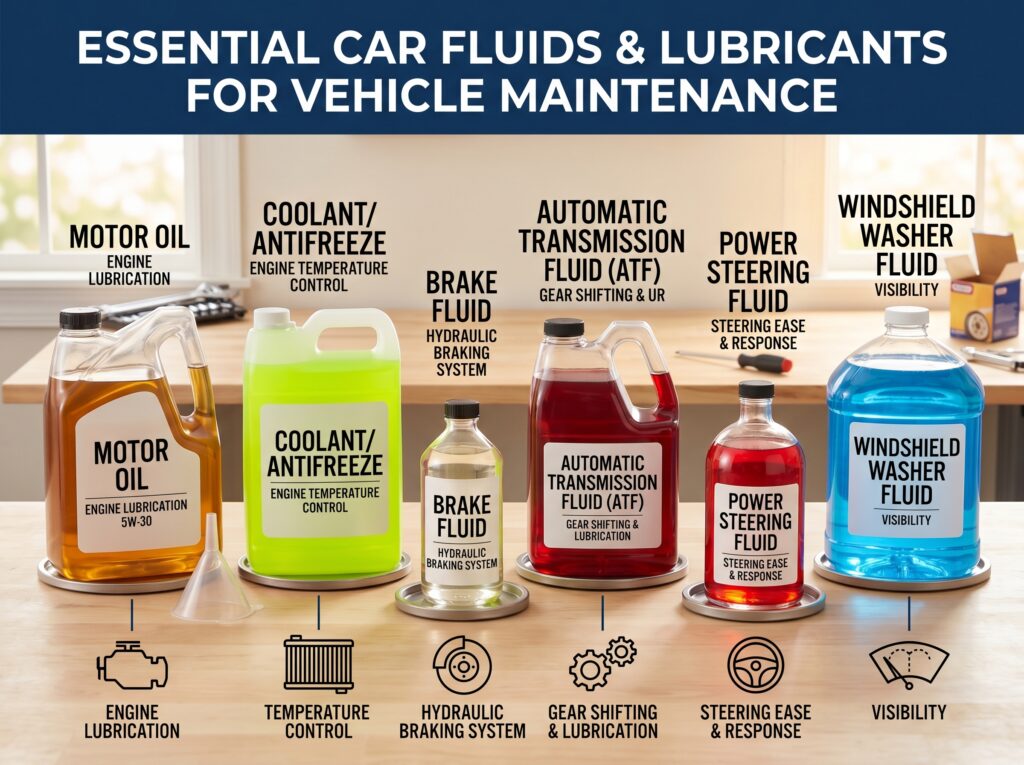
Every vehicle relies on a series of special liquids to function correctly. These fluids act as the lifeblood of the car, responsible for lubricating moving parts, reducing friction, cooling high-temperature components, transmitting power, and protecting systems against corrosion and wear. Without them, or if they are in poor condition, the engine would seize, the gears would fail, and safety systems like brakes or steering would stop working. For this reason, knowing exactly which fluids your car needs, how to check their level and condition, and when to replace them is one of the most important skills every driver should have. In this practical and complete guide, we explain the 5 essential fluids you must monitor, step by step, to keep your vehicle safe, reliable, and in perfect condition.
🔧 1. Engine Oil: The Most Critical Fluid
There is no doubt that engine oil is the most vital liquid in your car. Its main function is to create a protective film between all metal parts inside the engine — pistons, cylinders, crankshaft, and valves — preventing direct contact and friction. But it does much more: it also cleans the engine by removing dirt and combustion residues, cools the hottest areas, seals small gaps to maintain compression, and prevents rust. Driving with low oil level or degraded oil leads to rapid wear, overheating, and expensive breakdowns that can destroy the engine completely.
✅ How to Check It:
Perform this check at least once a month and before long trips. Park on level ground, turn off the engine, and wait 5 minutes for the oil to settle. Locate the dipstick, pull it out, wipe it clean with a cloth, reinsert it fully, and pull it out again. The mark must be between the MIN and MAX indicators. Observe the color: fresh oil is golden or light brown; if it is black, thick, or looks like mud, it is contaminated and needs replacement immediately.
⏱️ Replacement Interval:
Change it every 5,000 to 10,000 kilometers or every 6 to 12 months, depending on whether you use conventional or synthetic oil. Always respect the viscosity and specifications recommended by the manufacturer in your owner’s manual.
⚙️ 2. Transmission Fluid: Smooth Gear Shifts
Often forgotten, but equally important: transmission fluid is responsible for lubricating gears, bearings, and shafts inside the gearbox, whether manual or automatic. In automatic vehicles, this fluid works as a hydraulic medium too; it is what actually transmits the power to change gears. If this liquid is low, old, or dirty, gear changes become rough, jerky, or delayed, and internal components wear out quickly. Repairing a gearbox is one of the most expensive services, so maintaining this fluid is a smart investment.
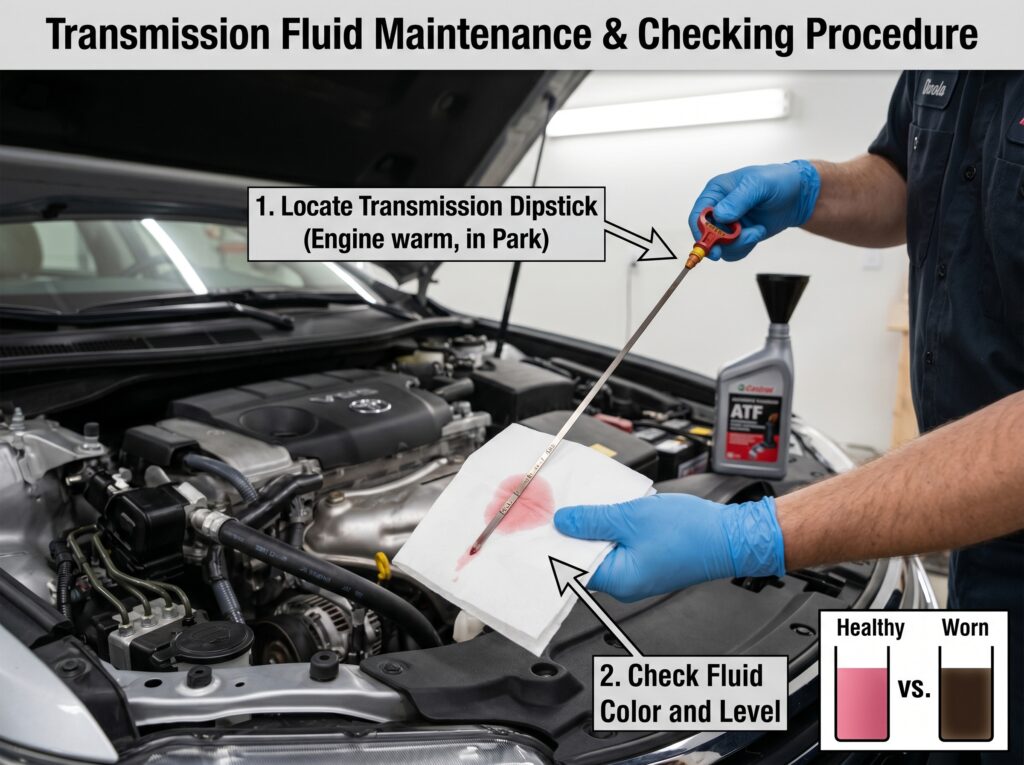
✅ How to Check It:
Manual gearboxes usually require a mechanic to check the level through a side plug. Automatic transmissions often have a dipstick similar to the engine, but the process is different: it is usually checked with the engine running and warm. The fluid must be transparent (red or green depending on the brand). If it smells burnt or is dark brown, it has lost its properties.
⏱️ Replacement Interval:
Change it every 40,000 to 60,000 kilometers or every 3 years. Even if your manual says “sealed for life”, experts recommend changing it to avoid problems in the long term.
❄️ 3. Coolant / Antifreeze: Temperature Control
The coolant (also known as antifreeze or radiator fluid) is the liquid that circulates around the engine block, absorbing the intense heat generated by combustion and carrying it to the radiator to be expelled. It performs three essential jobs: it keeps the engine from overheating in summer, prevents the liquid from freezing and cracking the block in winter, and protects the entire system against rust and corrosion. Never use just water; it boils too fast, freezes easily, and creates deposits that clog the radiator.
✅ How to Check It:
Check the transparent expansion tank, located near the radiator. ⚠️ SAFETY RULE: Never open the cap when the engine is hot; the liquid is under high pressure and can cause severe burns. Check only when cold. The level must be between the MIN and MAX lines. The color (green, pink, blue, or orange) depends on the brand, but it must always be clean and clear.
⏱️ Replacement Interval:
Coolant loses its chemical protection over time. Change it completely every 4 to 5 years or 80,000 kilometers. Always use the correct mixture (usually 50% coolant + 50% distilled water).
🎯 4. Power Steering Fluid: Light and Safe Driving
Vehicles with hydraulic steering systems depend entirely on power steering fluid to make turning the wheel easy and effortless. This liquid circulates under pressure, helping you maneuver smoothly, especially at low speeds or when parking. If the level drops due to leaks, or if the fluid gets old and thick, the assistance disappears: the wheel becomes stiff, heavy, or hard to turn. This is a safety risk because it increases the effort needed to drive and reduces your reaction time.
✅ How to Check It:
Locate the small reservoir, usually marked with a steering wheel icon. Check the level and color. It should be clear or slightly amber. If it is dark or smells burnt, it is degraded. If the level drops frequently, you have a leak in a hose or seal that must be repaired immediately.
⏱️ Replacement Interval:
Change it every 2 years or 40,000 kilometers. It is an inexpensive maintenance task that keeps the system silent and perfect.
🛑 5. Brake Fluid: Safety Above All
Of all the fluids, brake fluid is the most critical for your safety. It is a special hydraulic liquid designed to transmit force instantly from your foot on the pedal to the brakes on the wheels. Its unique property is that it does not compress, meaning every millimeter you move the pedal is transferred directly to the brake calipers. However, it has a weakness: it absorbs moisture from the air over time. Water inside the fluid lowers the boiling point, creates corrosion, and makes the pedal feel soft or spongy. In extreme cases, the fluid boils and you lose braking power completely.
✅ How to Check It:
The reservoir is located near the firewall. Check the level: it naturally drops a little as brake pads wear down, but if it is very low, you may have a leak or worn pads. The liquid must be clear or slightly yellow. If it is dark or brown, it is full of contamination and is dangerous.
⏱️ Replacement Interval:
Strict rule: change it completely every 2 years without exception, regardless of mileage. This is the cheapest way to ensure your brakes work perfectly and avoid expensive repairs to ABS modules or calipers.
📹 Video Guide: Step-by-Step Verification
Watch this video to see exactly where to find each fluid and how to perform the checks correctly:
📌 Conclusion: Small Tasks, Big Benefits
Taking care of your car’s fluids is the simplest, cheapest, and most effective way to extend the life of your vehicle and ensure safety. The five essential liquids you must always monitor are: Engine Oil, Transmission Fluid, Coolant, Power Steering Fluid, and Brake Fluid.
Checking levels, watching for leaks, observing color and condition, and replacing them at the right time are basic tasks that every driver can learn. Using only high-quality fluids and respecting the manufacturer’s specifications guarantees that your engine runs cool, gears shift smoothly, steering is light, and brakes stop safely.
Regular fluid maintenance is not an expense; it is an investment that prevents breakdowns, maintains performance, and protects your safety. Take care of the liquids, and your car will take care of you for many years.