Car Turbocharger: Function, Failures, Repair Options and Maintenance

The car turbocharger — often simply called a turbine — is one of the most brilliant and important inventions in modern engine technology. It is the component responsible for giving modern vehicles that extra power, efficiency, and performance we all love. Its main function is to force more air into the combustion chamber, allowing the engine to burn more fuel and generate significantly more power without needing a larger, heavier, or more thirsty engine. Today, it is found in almost all diesel cars, many gasoline vehicles, trucks, agricultural machinery, and even marine engines. However, because it works under extreme conditions — high temperatures, high speeds, and immense pressure — it is also a sensitive part that requires specific care. Understanding how it works, how to detect failures, what repair options exist, and how to maintain it is essential to avoid costly breakdowns and keep your engine strong. In this complete guide, we explain everything you need to know.
🔧 How Does a Turbocharger Work?
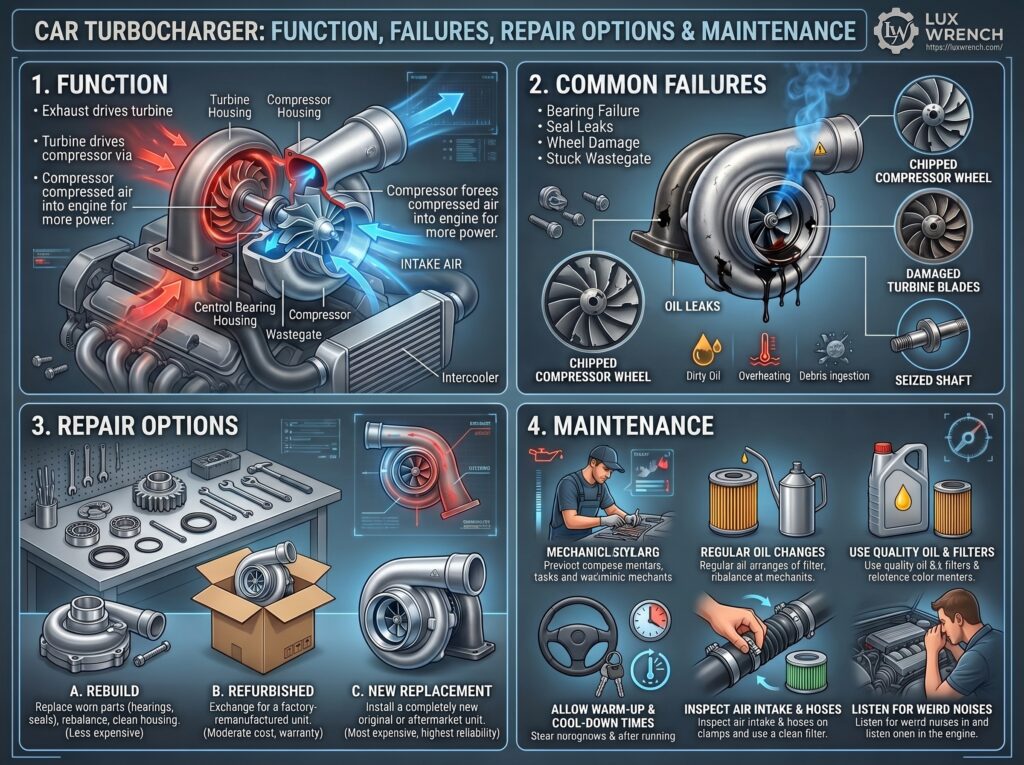
To understand failures and repairs, you first need to know the basics. The turbo is driven by the exhaust gases coming out of the engine. These gases spin a turbine wheel at incredibly high speeds — often over 100,000 revolutions per minute. This wheel is connected by a shaft to another wheel (the compressor) that sucks in fresh air, compresses it, and sends it under pressure into the engine cylinders. More air means more fuel can be burned, and more power is produced. It is a cycle that reuses energy that would otherwise be lost through the exhaust, making the engine much more efficient. However, because it spins so fast and gets so hot, it relies entirely on a constant supply of clean oil to lubricate and cool its internal bearings. If oil flow is interrupted or dirty, the turbo dies instantly.
⚠️ Common Symptoms of Turbocharger Problems
Like any mechanical part, the turbo wears out over time or gets damaged due to lack of maintenance, bad driving habits, or age. The good news is: **it always sends clear warning signs before breaking completely**. Recognizing these symptoms early can save you thousands in repairs and prevent engine destruction. These are the 5 most common signs:
1. 📉 Loss of Power and Poor Acceleration
This is the first and most noticeable symptom. You step on the gas, but the car does not respond as it used to. It feels sluggish, heavy, or slow to gain speed. Overtaking becomes difficult, and climbing hills requires lower gears. This happens because the turbine is not generating enough pressure, or there is a leak in the system. The engine works, but it feels like it has lost half its cylinders.
2. 💨 Blue, Gray, or Black Smoke from Exhaust
Smoke color tells you exactly what is wrong. Blue or gray smoke means oil is entering the combustion chamber and burning. This happens when internal seals fail, and oil leaks past the shaft into the air intake or exhaust. Black smoke usually means too much fuel and not enough air, indicating the turbo is not compressing air correctly or the air filter is blocked. If you see thick smoke when accelerating, your turbo is almost certainly damaged.
3. 🔊 Loud Whistling or Squealing Noises
A healthy turbo makes a soft, subtle “whoosh” sound that you barely hear. A failing one makes a loud, high-pitched whistle or scream that gets louder as you accelerate. This noise is caused by air escaping through cracks, holes, or loose connections in the pipes, or by damaged blades rubbing against the housing. If it sounds like a police siren under the hood, stop driving immediately.
4. 🛢️ High Oil Consumption and Leaks
Since the turbo runs on oil, any failure affects consumption. If you find yourself adding oil constantly but see no stains on the floor, it is likely being burned inside the turbo. You may also notice oil stains around the connections or on the exhaust side. This is a classic sign of worn seals or bearings.
5. 📈 Difficulty Maintaining Speed
On the highway, the car struggles to stay at constant speed, or the power comes and goes intermittently. This is often due to a stuck wastegate or variable geometry mechanism, which controls the pressure. It gets worse as the engine heats up.
🛠️ Repair Options: Reconditioning vs. Hybrid Turbo Upgrade
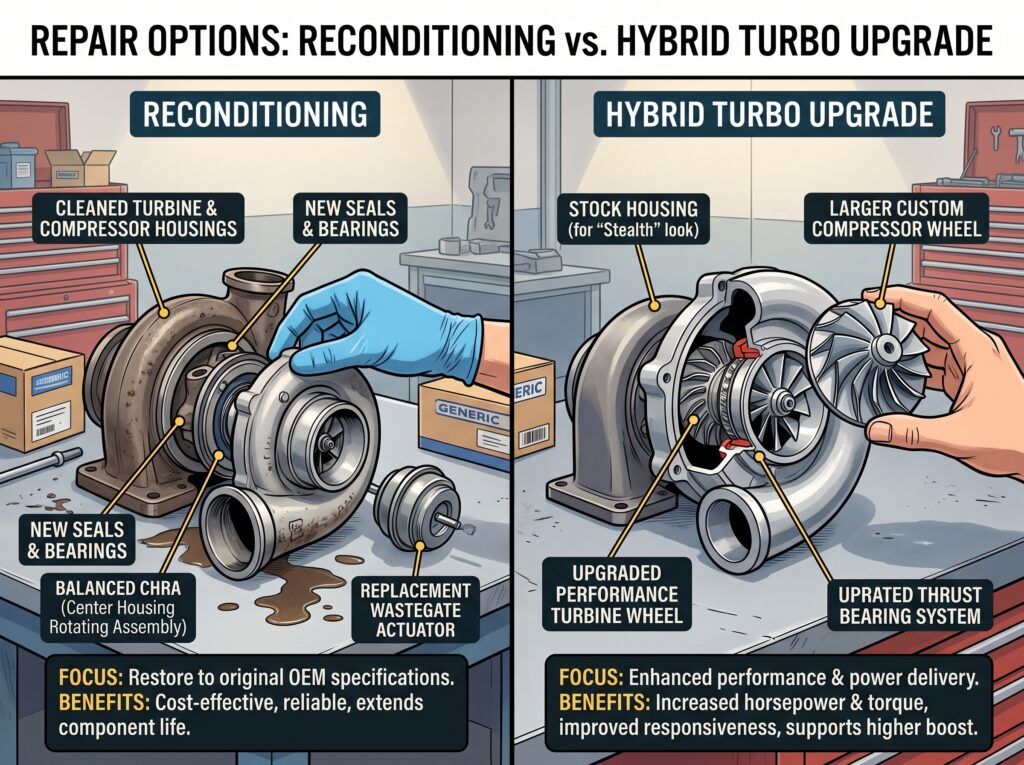
When the diagnosis confirms the turbo is damaged, you have two main paths to solve it. Choosing the right one depends on your budget, your goals, and how long you plan to keep the car.
1. 🔩 Turbo Reconditioning (Rebuilding)
This is the most common and economical solution. Instead of throwing away the whole unit, specialists disassemble it completely, inspect every millimeter, and replace **only the worn or damaged internal parts** — bearings, seals, shafts, rings, and gaskets. They clean the housing, check for cracks, and then reassemble and balance it with high precision to ensure it spins perfectly again.
✅ Advantages: It costs significantly less than buying a new or original turbo. It is the smart choice if you just want to get the car back to normal operation and save money. When done by professionals, a reconditioned turbo works exactly like new and lasts as long as the original one.
❌ Disadvantages: You must go to a specialized workshop. A bad rebuild will fail quickly and destroy your engine. Always demand a warranty.
2. ⚡ Hybrid Turbocharger Upgrade

This is the best option if you are already repairing it and want to improve performance. A hybrid turbo is not just a repair; it is an upgrade. Specialists take your original housing but replace the internal components with **stronger, larger, and more efficient parts** designed for higher performance: bigger wheels, reinforced shafts, better bearings, and improved aerodynamics.
✅ Advantages: You get more power, better response at low RPM, higher compression efficiency, and often better fuel consumption. It is much stronger and more durable than the original because it uses upgraded materials. It is a smart investment because you fix the problem and gain performance at the same time.
❌ Disadvantages: It costs a bit more than a standard rebuild, but still much less than a new high-performance turbo. It is compatible with your engine and does not require major modifications.
💡 Critical Care: How to Extend Turbo Life After Repair
Whether you choose a standard repair or a hybrid upgrade, the new life of your turbo depends entirely on how you treat it. The majority of failures happen due to bad habits or lack of maintenance, not because of defective parts. Follow these rules strictly:
- ✅ Oil is Everything: The turbo spins at 100,000 RPM and gets very hot. It needs **clean, high-quality oil** flowing constantly. Change oil every 5,000–7,000 km or every year, using only the viscosity and specification recommended by the manufacturer. Never use cheap oil or filters. Contaminated oil is the number one turbo killer.
- ✅ Warm Up and Cool Down: This is the golden rule. When starting cold: Drive gently for the first 5 minutes. Do not accelerate hard until the oil is hot and circulating everywhere. When stopping: After long trips or driving fast, let the engine idle for 1–2 minutes before turning it off. This allows the turbo to cool down gradually. If you turn it off immediately, the oil left inside boils, turns into carbon, and destroys the bearings next time you start.
- ✅ Break-In Period: After repair or installation, drive gently for the first 100–200 kilometers. Avoid maximum acceleration or high RPM to let the new parts settle perfectly.
- ✅ Check Air Filters: If the air filter is clogged or broken, dust and dirt enter the turbo and act like sandpaper, destroying it in months. Change filters regularly.
📹 Video Guide: How It Works and How to Fix It
Watch this video to understand visually how the turbo works, what breaks, and how to repair it:
📌 Conclusion: Performance and Durability in Your Hands
The car turbocharger is a marvel of engineering that gives your engine power and efficiency. It is robust, but it is not invincible. It needs good oil, gentle treatment, and regular care.
Recognizing symptoms early — power loss, smoke, whistling — allows you to choose between reconditioning or upgrading to a hybrid turbo. Reconditioning is the economical and effective solution to return to original performance. The hybrid upgrade is the smart choice if you want more power and better durability while you repair.
Remember: 90% of turbo failures are caused by bad maintenance or bad driving habits, not manufacturing defects. Change your oil on time, warm up the engine, cool it down before stopping, and use quality filters. With these simple habits, your turbo will easily last the entire life of the car, giving you power, efficiency, and reliability for thousands of kilometers.